



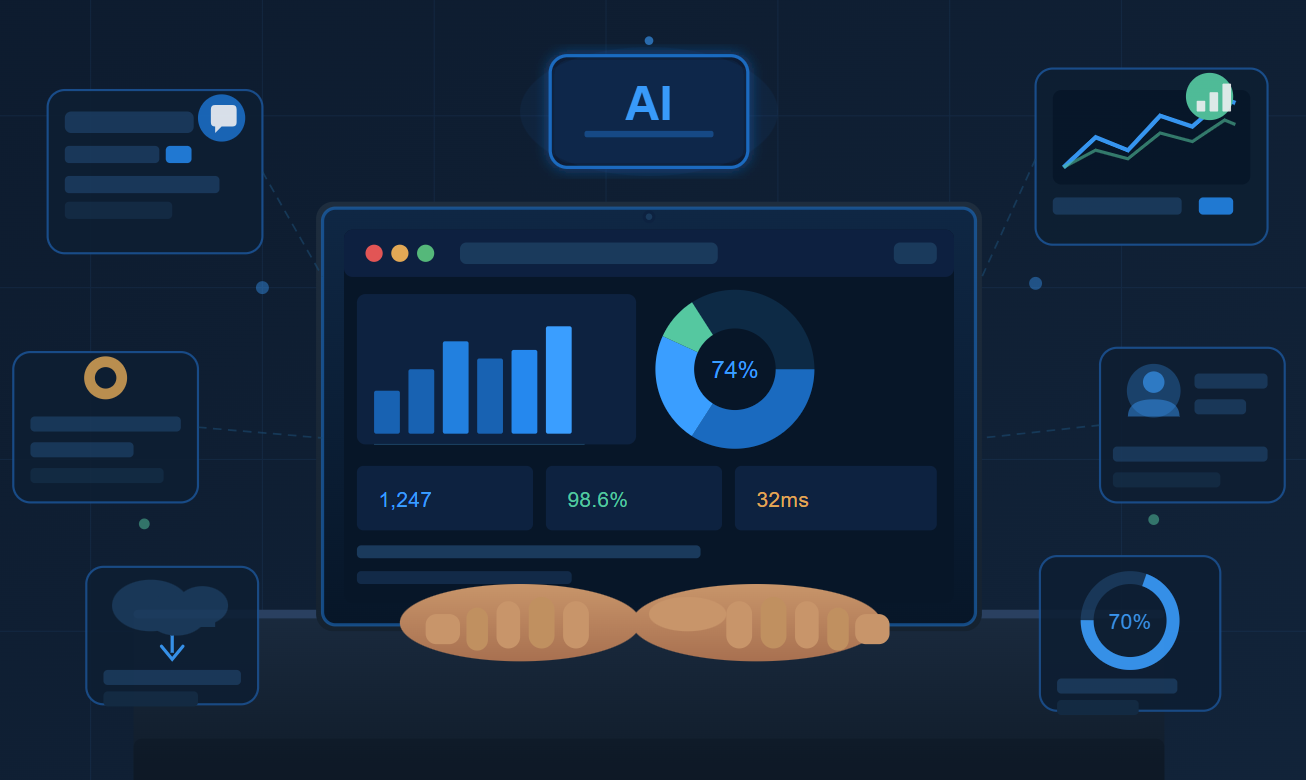
AI in finance is transforming how businesses manage reporting, forecasting, and operational efficiency. However, while automation can improve speed and accuracy, sustainable financial growth still depends on human judgment, strategic oversight, and experienced leadership.
For growing businesses across Canada and the United States, finance teams are under increasing pressure to move faster while maintaining visibility, compliance, and profitability. AI-powered tools are helping organizations automate repetitive tasks and process large volumes of data more efficiently. Yet faster information alone does not guarantee better decisions.
The strongest finance strategies today combine automation with experienced financial leadership. AI supports efficiency, while finance professionals provide the context, strategic thinking, and operational insight businesses need to grow confidently.
At The Finance Group Global, we help businesses balance modern financial technology with practical financial leadership through fractional CFO, bookkeeping, payroll, and controller support.
The Rise of AI in Finance
Finance teams now have access to more data than ever before. Every invoice, payroll entry, transaction, and operational metric creates information that businesses can use to improve decision-making.
As a result, AI in finance has grown rapidly. Businesses are adopting AI-powered financial tools to:
- Automate repetitive accounting workflows
- Improve forecasting accuracy
- Monitor cash flow in real time
- Accelerate reporting cycles
- Reduce manual errors
- Improve financial visibility across departments
For lean or growing companies, these tools can create meaningful operational efficiencies.
However, there is an important distinction many leaders are beginning to recognize. Faster reporting does not automatically create stronger financial strategy.
AI can identify patterns and generate recommendations, but it cannot fully understand leadership priorities, operational realities, or the long-term business implications behind every decision.
A forecast may appear accurate from a purely analytical perspective while overlooking customer experience risks, staffing challenges, or market conditions that experienced finance professionals immediately recognize.
That is why the future of finance is not AI versus people. It is AI supported by human expertise.
Why Businesses Are Adopting AI in Finance Solutions
Businesses are increasingly adopting AI because finance departments are expected to deliver more insight in less time.
Leadership teams want real-time reporting, stronger forecasting, and operational visibility while maintaining lean internal structures. At the same time, companies are managing tighter margins, rising labor costs, and growing compliance demands.
This is where AI in finance creates immediate value.
AI systems can process large volumes of financial data far faster than traditional manual workflows. Tasks that once required hours of spreadsheet work can now happen automatically.
Common advantages include:
- Faster reconciliations
- Automated variance analysis
- Real-time dashboard reporting
- Improved reporting consistency
- Reduced administrative workload
- Enhanced fraud detection capabilities
According to McKinsey & Company, many finance leaders are already using generative AI for forecasting, spend analysis, and operational planning.
Still, the biggest advantage may not simply be efficiency.
When finance teams spend less time organizing information, they gain more capacity for strategic work. Instead of functioning only as report builders, finance professionals can focus on planning, analysis, operational guidance, and growth strategy.
For many businesses, that shift is critical.
Where AI in Finance Delivers the Most Value
AI performs exceptionally well when managing structured, repeatable financial tasks.
It can analyze large datasets, identify anomalies, automate workflows, and process financial information quickly and consistently.
Some of the most effective uses of AI in finance include:
Automated Reporting
AI-powered reporting systems reduce manual data compilation and improve reporting consistency across departments.
Cash Flow Monitoring
Real-time monitoring tools help businesses identify cash flow risks earlier and improve short-term financial visibility.
Forecast Modeling
AI can analyze historical financial data to generate forecasting models and identify operational trends.
Fraud Detection
AI systems can quickly flag suspicious transactions or unusual spending patterns that may require investigation.
Expense Categorization and Reconciliation
Automation significantly reduces the manual effort involved in transaction coding and account reconciliation.
These capabilities help businesses improve efficiency and reduce time spent on repetitive administrative work.
What Still Requires Human Financial Expertise
Although AI improves efficiency, finance is not purely analytical.
Financial decisions exist within a broader business context that includes people, operations, market conditions, leadership priorities, and long-term strategy.
This is where human expertise remains essential.
Experienced finance professionals understand:
- Operational realities
- Industry-specific risks
- Leadership priorities
- Customer and employee impact
- Stakeholder relationships
- Regulatory considerations
- Long-term business strategy
An AI system may recommend aggressive cost reductions based on short-term trends. However, an experienced CFO or controller may recognize that the decline is temporary or tied to seasonal market shifts.
Without that context, businesses risk making reactive decisions that negatively affect growth, customer retention, or team stability.
AI provides information.
Experienced finance professionals determine what that information actually means for the business.
This balance is particularly important during periods of growth, operational change, or economic uncertainty.
The Risks of Over-Relying on Automation
One of the biggest risks businesses face is assuming automated outputs are always correct.
AI systems are only as effective as the quality of the data, assumptions, and rules behind them. If information is incomplete or lacks context, recommendations can quickly become misleading.
According to Deloitte Insights, organizations often make weaker decisions when leaders rely too heavily on automation without critical review.
Detailed reports can create a false sense of certainty.
However, financial decision-making rarely operates in absolutes.
Strong finance leaders continuously evaluate:
- What assumptions the system is making
- Whether important operational context is missing
- How recommendations align with broader business goals
- The long-term implications of short-term financial decisions
AI should improve strategic thinking, not replace it.
Why Human-in-the-Loop Finance Works Best
Many organizations are now adopting a human-in-the-loop finance model.
In this approach, AI handles repetitive and data-intensive workflows while finance professionals remain responsible for oversight, interpretation, and final decision-making.
This balance creates stronger operational outcomes.
Businesses benefit from:
- Faster reporting cycles
- Better financial visibility
- Improved operational efficiency
- Stronger strategic oversight
- Reduced administrative burden
- Better long-term decision-making
For growing businesses, this collaborative model is often the most effective.
Technology improves speed and visibility, while experienced finance professionals provide the strategic guidance leadership teams need.
This is also why many companies work with fractional CFO services, outsourced controllers, and external finance partners.
The right finance partner becomes an extension of the business by helping leadership teams maintain financial clarity without significantly expanding internal infrastructure.
Which Financial Decisions Should AI Handle?
Not every financial decision should be automated.
Businesses need clear boundaries around where automation creates value and where human involvement remains essential.
Low-Risk Tasks Ideal for Automation
AI works well for repetitive and highly structured workflows such as:
- Invoice processing
- Expense approvals
- Data entry
- Account verification
- Routine reporting
Medium-Risk Decisions That Require Human Review
Some workflows benefit from AI support combined with financial oversight, including:
- Budget variance analysis
- Forecast adjustments
- Spend management analysis
- Working capital reviews
In these situations, automation improves efficiency while finance professionals validate recommendations before action is taken.
High-Risk Decisions Should Remain Human-Led
Strategic decisions should continue to rely heavily on experienced financial leadership.
This includes:
- Mergers and acquisitions
- Workforce restructuring
- Crisis management
- Major investments
- Long-term strategic planning
These decisions involve uncertainty, operational complexity, and human impact that AI cannot fully evaluate.
How AI in Finance Supports Strategic Financial Leadership
One of the most valuable benefits of AI in finance is that it reduces time spent on repetitive administrative tasks.
Traditionally, finance teams spent significant portions of their day compiling spreadsheets, reconciling accounts, preparing reports, and organizing financial information.
AI changes that dynamic.
By automating routine processes, finance teams gain more capacity for:
- Strategic planning
- Scenario analysis
- Risk management
- Operational support
- Leadership communication
- Growth planning
McKinsey research suggests AI can reduce time spent on data processing by up to 30%.
That additional capacity allows finance professionals to focus on higher-value work that directly supports business growth.
For scaling businesses, this shift is especially important.
As operations become more complex, leadership teams need stronger financial visibility and guidance without dramatically increasing overhead.
That is where strategic finance support becomes increasingly valuable.
Services such as controller support, outsourced bookkeeping, and payroll management help businesses maintain operational stability while leadership focuses on growth.
Why Governance and Financial Oversight Matter
As businesses increase their use of AI, responsible AI governance becomes more important.
Financial systems cannot operate on automation alone. Businesses need accountability, transparency, and oversight to ensure AI-generated recommendations remain accurate and aligned with company priorities.
Strong financial governance includes:
- Clear approval workflows
- Audit trails
- Ethical oversight
- Ongoing monitoring for bias or errors
- Defined leadership accountability
Finance leaders also need visibility into how automated systems generate outputs.
Understanding the assumptions behind recommendations helps businesses identify risks early and maintain confidence in financial decision-making.
Technology should strengthen trust in financial operations, not reduce transparency.
The Human Skills AI in Finance Cannot Replace
Despite rapid advancements in automation, some finance skills remain deeply human.
AI cannot replicate:
- Emotional intelligence
- Leadership judgment
- Relationship-building
- Negotiation skills
- Strategic communication
- Experience-based decision-making
These skills become especially important during uncertainty, organizational change, or periods of rapid growth.
Strong finance leadership requires more than technical analysis.
It requires perspective.
An AI system may identify a financially efficient solution, but experienced finance professionals understand how those decisions affect employees, customers, investors, and long-term company culture.
That human insight is what transforms financial data into meaningful business strategy.
The Future of AI in Finance Is Balance
AI in finance is reshaping the industry in powerful ways. Businesses now have access to tools that improve reporting accuracy, automate workflows, strengthen forecasting, and process financial data faster than ever before.
However, automation alone is not enough.
The businesses that benefit most from AI will not be the ones that remove people from financial decision-making. Instead, they will be the companies that combine technology with experienced financial leadership.
When businesses balance automation with human expertise, they create:
- Stronger financial decision-making
- Better operational alignment
- Improved visibility
- More sustainable growth
- Greater long-term stability
At The Finance Group Global, we help growing businesses build finance functions that combine modern systems with strategic leadership. Whether you need bookkeeping support, controller oversight, payroll management, or fractional CFO guidance, our team helps businesses create financial clarity that supports long-term growth.
If your business is exploring how to integrate AI into your financial operations without losing strategic oversight, we are here to help.

Dorothy Zubel CPA, CMA
Co-Founder, CEO
 Follow on Linkedin